
 Gadi Feldman
 ControlUp has launched Pulse AI, an intelligent platform designed to streamline IT operations by correlating data across IT environments to reduce manual troubleshooting and facilitate autonomous actions.
- Its initial feature, AI Assistant, enables IT administrators to use natural language for troubleshooting, consolidating insights from integrated systems, providing contextual answers, and executing direct remediation.
- Pulse AI aims to evolve beyond assisted troubleshooting to predictive analytics and autonomous remediation, leading to a self-managing IT infrastructure.
- The system reduces cognitive load on IT teams by automating data correlation and context-switching, allowing professionals to focus on strategic problem-solving.
Here’s what a typical Tuesday looks like for most IT admins: You get five tickets from users saying Microsoft Teams keeps freezing on their laptops. You open your endpoint management console to check the affected devices. CPU looks fine, memory’s okay, nothing jumping out. You switch to your network monitoring tool to see if there’s a connectivity issue. Everything looks normal. You jump into the Teams admin center to check service health. No outages reported. You open your patch management system to see if a recent update might be causing it. There was a Windows update last week, but it went to everyone, not just these five users. You check ServiceNow to see if there are more tickets you haven’t seen yet. Now you’re 30 minutes in, you’ve visited six different admin consoles, and you still don’t know why Teams is crashing.
This is the reality of modern IT operations. The tools got better, the data got richer, but the cognitive load on IT teams keeps growing. You’re not just managing technology anymore, you’re playing detective across a dozen different admin consoles, trying to connect dots that shouldn’t be scattered in the first place.
We think there’s a better way.
Introducing Pulse AI: The Heartbeat of Autonomous IT
Today we’re launching ControlUp AI Assistant, the first feature powered by Pulse AI, our agentic AI service that’s going to transform how IT operations work.
But before we talk about what the AI Assistant does, let’s talk about what Pulse AI actually is.
Pulse AI is ControlUp’s intelligence layer, continuously correlating signals across your IT environment, understanding context and driving action without manual intervention. Autonomous not in a hand wavy, science fiction sense, but in a practical one: systems that understand what’s happening, anticipate issues and take action without waiting for humans to connect the dots. It’s the AI service that will eventually connect every tool in your IT stack, understand the relationships between them, predict problems before they happen, and resolve issues without waiting for someone to notice.
Think of it as the central nervous system for your digital workplace. Right now, your IT environment is a collection of disconnected systems that don’t communicate. Pulse AI is the intelligence layer that makes sense of all of it. Correlating data, understanding context, taking action, and learning from every interaction.
The AI Assistant is just the beginning of what Pulse AI will do.
AI Assistant: The First Feature Powered by Pulse AI
AI Assistant is how we’re starting this journey. It’s AI that lives inside the ControlUp platform and fundamentally changes how you interact with your IT environment.
Instead of logging into six different admin consoles and manually correlating data, you just ask. “Why is Teams freezing for these five users?” The AI Assistant goes to work, it checks your ControlUp data, pulls information from your integrated services (Intune, Teams admin center, your network monitoring, your ticketing system), correlates everything, and gives you an actual answer with context. Not a report to interpret. Not a bunch of metrics to cross-reference. An answer.
But here’s where it gets interesting: The AI Assistant doesn’t just query data. It understands what that data means in the context of your environment. If it sees that those five users are all running a specific GPU driver version, combined with a recent Teams update and a particular Windows build, it connects those dots. It knows that these things together tell a story, and it tells you that story in plain language.
The best part? It can take action. Want to run a remediation script? Update a ticket? AI Assistant can do it, right from the conversation. You’re not just talking to a chatbot that reads databases, you’re working with an extension of your IT team that has access to everything and can actually help you fix problems.
Why This Matters More Than You Think
Yes, having “ChatGPT for IT” is huge. Being able to ask questions in natural language instead of building complex queries or clicking through endless menus is genuinely game-changing. Any IT admin who’s tried it immediately gets why this matters.
But the AI Assistant is solving a bigger problem than natural language interfaces. It’s solving the context-switching nightmare that kills productivity in modern IT operations.
Right now, when something goes wrong, you’re not just troubleshooting the technical issue, you’re troubleshooting your own workflow. Which console has the data I need? What’s the relationship between this metric and that one? Did I check the related service? Is there an open ticket about this already? Your brain becomes the integration layer between all your tools, and that’s exhausting.
The AI Assistant eliminates that overhead. It already knows where all your data lives. It already understands how your services relate to each other. It’s already checked everything that matters. You get to focus on making decisions and solving problems instead of hunting for information and playing correlation detective.
What IT Teams Can Actually Do With This
The use cases are broader than you might think. Obviously, troubleshooting is huge, when something breaks, you want answers fast, and the AI Assistant delivers. But that’s just the beginning.
Users complaining about slow performance? You used to check CPU across all hosts, memory usage, disk I/O, network latency, then correlate with time of day and active sessions. Now you just ask ‘why is performance slow in the accounting department?’ and get an answer.
Security and compliance turn into natural interactions. “Show me all devices that haven’t checked in for 30 days and are still marked as active in our inventory.” The AI Assistant knows where to look, what to correlate, and how to present findings that you can actually act on.
Onboarding new team members gets dramatically faster. Instead of training someone on where to find data across a dozen different tools, you teach them to ask good questions. The AI Assistant handles the rest. The knowledge that usually lives in the heads of your senior admins becomes accessible to everyone.
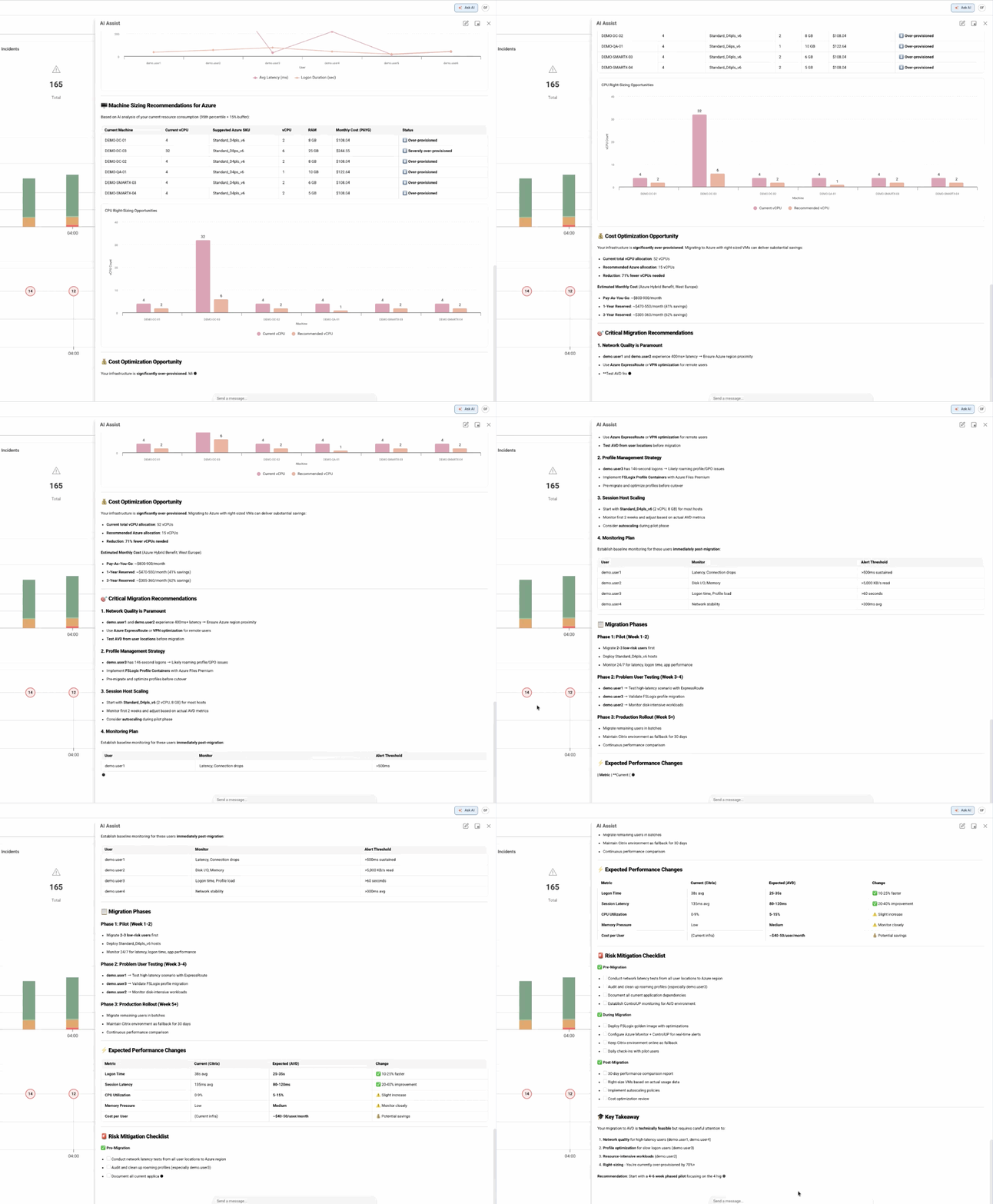
Even strategic planning changes. “What would happen to our VDI performance if we migrated the engineering team to Azure Virtual Desktop?” AI Assistantcan pull historical usage patterns, compare them against AVD capabilities, and give you a real assessment based on your actual environment, not generic best practices from a whitepaper.
The Bigger Picture: What Pulse AI Will Power Next
AI Assistant is powerful on its own, but it’s really just the first capability powered by Pulse AI. As we continue building, Pulse AI will drive more and more autonomous operations, moving your IT infrastructure from reactive problem-solving to predictive, self-healing systems.
Imagine waking up to a message that says “I noticed a pattern in your session host performance that typically leads to login storms. I’ve already scaled up capacity during your peak hours for the next two weeks, and I’m monitoring to see if we need to make this permanent.” That’s not science fiction. This is where we’re heading.
Or picture this: a ransomware variant starts spreading through your environment. Pulse AI notices the anomalous behavior, automatically isolates the affected endpoints, kicks off your incident response playbook, generates the executive summary for your CISO, and starts remediation, all before you’ve finished your morning coffee. That’s autonomous IT operations powered by intelligent AI agents.
AI Assistant is us proving that agentic AI can meaningfully help IT teams right now, today, with real problems. But it’s also the foundation for everything else Pulse AI will power, predictive analytics, autonomous remediation, intelligent automation, and eventually a self-managing IT environment.
This Changes How You Think About IT Tools
Here’s something we’ve learned building this: once you have an AI service that can talk to all your tools, the individual tools matter less and the data matters more. You stop caring about which admin console has the feature you need because you’re not visiting admin consoles anymore, you’re having conversations that pull from everything.
This is why we’re investing so heavily in integrations for Pulse AI. Every service we connect makes AI Assistant smarter and more useful – and makes future Pulse AI-powered features even more powerful. Your Azure environment, your EDR platform, your ticketing system, your identity provider, when Pulse AI can pull from all of them and correlate the data, you get insights that were previously impossible without manual detective work.
IT professionals shouldn’t be glorified data gatherers. You’re problem solvers, architects, innovators—but you’re spending your days copying information between admin consoles instead of actually solving problems.
We’re building Pulse AI for IT teams who are done accepting this as normal. Your job is to solve problems, not to be the integration layer between your tools. Let Pulse AI handle the correlation.
This is just the beginning of what Pulse AI can do. We’re shipping fast, learning constantly, and building toward a vision of IT operations that’s genuinely different from what exists today. An IT environment that’s smart enough to manage itself, predictive enough to prevent problems, and autonomous enough to free your team from the tedious work that eats up their day.
The future of IT operations isn’t about better dashboards or more alerts. It’s about intelligent systems that understand themselves and take care of themselves. Pulse AI is the engine that makes that possible, and we’re building new capabilities on top of it every day.
Want to see what this looks like for your environment? Reach out to our team.