 Simon Townsend
 Most IT teams find out something is wrong when a ticket arrives. By then, the damage is already done. Proactive Synthetic Monitoring continuously simulates real user activity — logins, app flows, network paths — to catch issues before they reach employees.
- Detect degradation before it's a disruption, reducing Mean-Time-To-Availability (MTTA)
- Resolve incidents autonomously, before a single ticket is raised
- Move from a reactive IT model to a self-healing digital workspace
Elite athletes stopped guessing how to improve performance years ago. It’s time IT operations caught up, and the metrics to do it are already here.
In the world of professional sports, guessing isn’t part of the game. Athletes don’t just feel tired; they check their stats on an Apple Watch, Fitbit, or a WHOOP. By tracking high-frequency signals like heart rate variability and sleep cycles, WHOOP helps athletes move from reactive recovery to proactive performance.
But while athletes continuously optimize their bodies with precision, many IT teams still manage their digital workspaces by waiting for a ticket to break the silence.
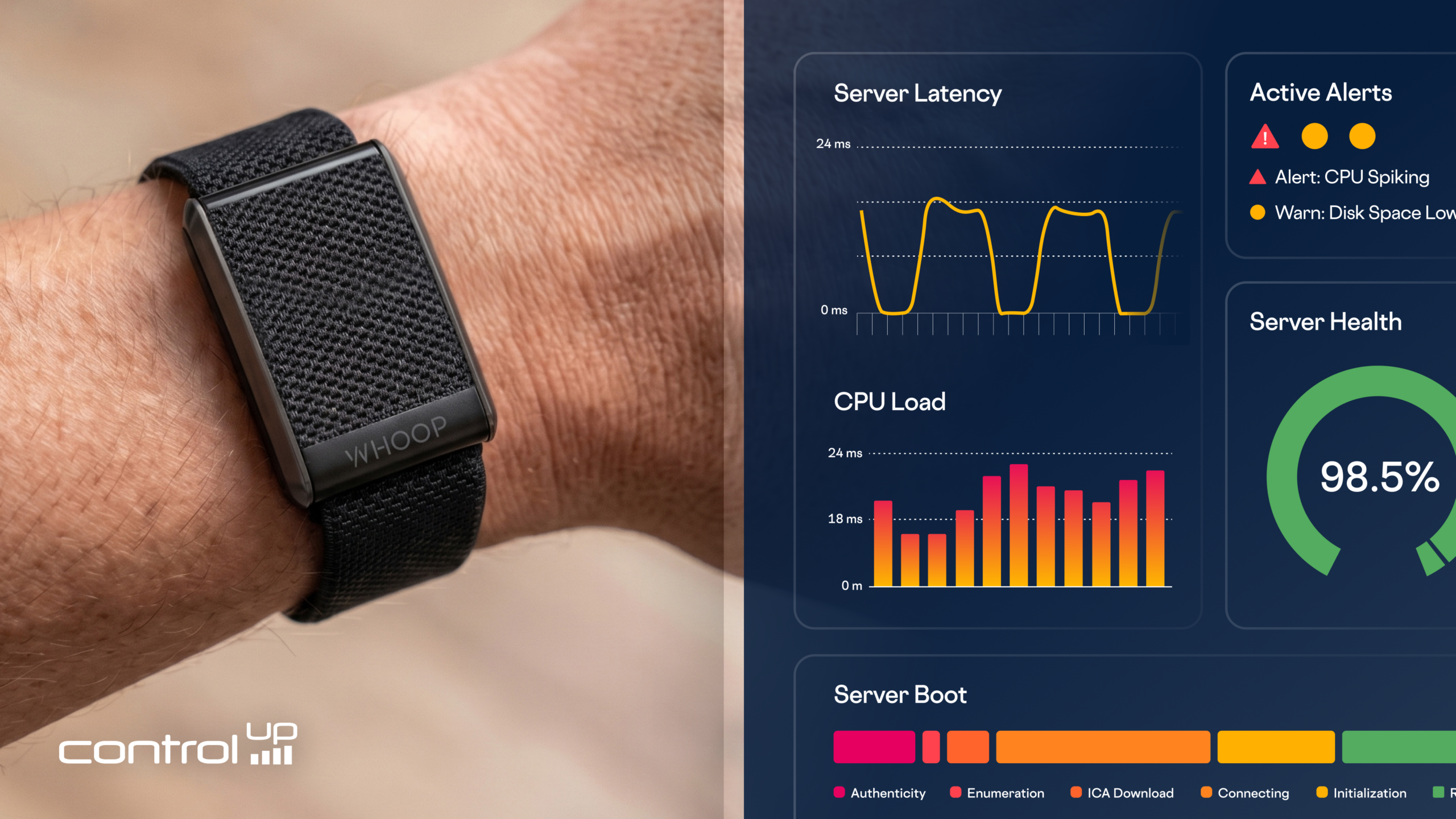
There is a better way. We see Proactive Synthetic Monitoring as the “WHOOP for your Digital Workspace.” Here’s how comparing these two performance approaches can redefine your strategy for Autonomous Endpoint Management (AEM).
From Reactive Uptime to Proactive Readiness
A WHOOP device doesn’t just tell you if your heart is beating (that’s uptime). It tells you if you are ready to perform. Standard IT monitoring makes the same mistake. It tells you whether a server is up and running, but not whether the experience on the other side is any good.
Proactive Synthetic Monitoring goes further by continuously simulating logins, testing SaaS application responsiveness, and checking network paths before the first employee even logs on for the day.
The Athlete
Before lacing up, an athlete checks their readiness score. HRV, sleep cycles, and strain data combine to answer one question: should I push hard today, or hold back?
The IT Team
Workspace readiness happens automatically, before 9 AM. Synthetic tests simulate logins, app flows, and network paths so failures are caught at 6:00 AM, not during the 9:00 AM all-hands.
- The goal: Identify failures or slowdowns before they impact the workday.
- The outcome: Resolve the glitch early so meetings start without a hitch.
Eliminating the Hidden Stressors & Closing the MTTA Gap
Athletes use wearable data to spot invisible strain, like a coming illness, before multiple symptoms appear. That early-warning capability is a superpower IT has never had… until now.
Because without the right tools, digital friction accumulates silently. Issues remain invisible until they become a crisis. And by the time tickets surface, the damage is already underway. How long does it take your team to know something is wrong?
Mean-Time-To-Availability (MTTA): A Metric That Matters
MTTA measures the average time between when an incident occurs and when your team acknowledges it. According to a TechTarget report citing Oxford Economics research, unplanned downtime costs organizations an average of $9,000/minute or $540,000/hour. That clock starts the moment something goes wrong, not the moment a ticket lands in the queue.
The implication is significant. Traditional endpoint and application monitoring wait for failures to announce themselves. Proactive Synthetic Monitoring changes the model. By continuously simulating real user behavior across your environment, ControlUp detects degradation before it becomes a disruption. That means many incidents are identified and remediated before a ticket is ever raised, and before a single dollar of downtime cost accrues.
That’s a faster response, but it’s also a fundamentally different operating model.
With ControlUp, the MTTA conversation shifts. The goal isn’t to acknowledge incidents faster, but rather to resolve them as soon as they emerge.
Our synthetic testing acts as your early warning system. It simulates real user behavior to uncover latency in Microsoft Teams sessions, VDI environments, or SaaS applications before your workforce even notices.
- Agentic AI engine: Pulse AI interprets these signals and correlates them with real-time telemetry to recommend the next-best action.
- Autonomous fixes: Once a synthetic test flags a bottleneck, our AEM platform triggers self-healing workflows to remediate the issue on autopilot.
Choosing Precision Over Guesswork
WHOOP replaces “I think I’m overtraining” guesswork with hard data. ControlUp does the same for IT, removing the guesswork of whether the network is slow, an app is lagging, or a session is degraded.
By running proactive tests across physical, virtual, and cloud desktops, IT gains a macro-to-micro view of the entire environment.
Full-Stack Visibility
Know exactly where the issue lives. Whether on the device, browser, network, or the application itself, ControlUp pinpoints the precise problem layer before the user feels digital friction.
Resolved Before Reported
Fix before a ticket opens. Like an athlete adjusting their training plan based on a recovery score, IT adjusts the environment based on synthetic signals.
“The best workdays aren’t defined by the problems you solved. They’re defined by the disruptions that never happened.”
What we’re describing is so much more than faster incident response. It’s a move towards a digital workspace that runs itself. By unifying Agentic AI with Digital Employee Experience (DEX) signals, ControlUp ONE orchestrates a self-healing environment. We monitor performance and initiate autonomous remediation to ensure your digital workspace is always shift-ready.
How many invisible issues are currently draining your team’s productivity before the workday even begins?