- → What it is: An AI-driven approach that automatically monitors, diagnoses, and resolves endpoint issues across devices, VDI/DaaS, mobile, and SaaS environments
- → What it replaces: Reactive, manual troubleshooting across fragmented tools and dashboards
- → What it delivers: Reduced downtime, lower IT overhead, and a measurably better Digital Employee Experience (DEX)
- → How it works: Agentic AI detects anomalies, performs root cause analysis, and triggers automated IT operations to resolve issues before users feel the impact
- → Who it’s for: IT teams managing complex, distributed, or hybrid environments at scale, as well as C-suite leaders looking to cut operational costs, consolidate tools, and scale IT without scaling headcount
ControlUp ONE is an AI-powered AEM platform built around these principles, combining leading DEX capabilities such as real-time telemetry, predictive maintenance, and autonomous IT ops in a single operational layer.
What Is Autonomous Endpoint Management?
Autonomous endpoint management (AEM) is a system for automatically monitoring endpoints, such as laptops, mobile devices, and virtual environments. Traditional and even modern endpoint management solutions often require manual work. AEM is different. It uses intelligent automation, driven by AI, to:- Detect issues with endpoints
- Decide the best solution
- Resolve problems in real time
Importance of AEM in Modern IT
AEM shifts organizations from reactive to proactive IT operations. In highly distributed, complex tech ecosystems, effective IT management can often become unsustainable. AEM fixes this by automatically pinpointing and mitigating issues so the IT team doesn’t feel like it’s always playing catch-up.For example, suppose a healthcare IT team needs to support telehealth platforms so doctors and patients can enjoy uninterrupted virtual visits. AEM can proactively monitor each participant’s endpoint to detect and address data transfer issues and bottlenecks. The system can then solve the problem without IT having to lift a finger.

The Role of AI in AEM
Agentic AI powers AEM. The system uses it to detect anomalies and make decisions. This puts AI into IT operations, letting the agent take immediate action without manual assistance.To illustrate, let’s say a managed services provider (MSP) is running an AEM solution. The AI at the heart of the AEM identifies a software conflict across multiple clients. It ascertains that the software conflict stems from a recent update. IT automation can then automatically roll back the update and deploy a compatibility patch. The AI also produces a report so the IT team understands the issue and the AEM’s resolution.
Core Components of an AEM Platform
An AEM platform gives you a stack of tools that work together like a team. Each element has a unique role, and they combine to form a comprehensive endpoint management system.
Intelligent Device Management
Your AEM platform provides deep visibility into how your endpoints perform and their overall health. If the AEM sees a problem, it fixes it.Take a hospital, for instance. Not all devices are created equal, especially when some support patients’ lives and empower clinicians to perform time-sensitive work. Knowing this, a hospital’s AEM can continuously monitor all life-critical applications to make sure they remain responsive. If an app isn’t responding, the AEM can automatically restart the service that powers it. It can also check whether the app is connected to the necessary backend systems—and reestablish connections when needed.

Predictive Maintenance for Endpoints
Your AEM analyzes endpoint data to prevent failures before they impact workflows. Over time, even the most effective systems experience degradation. AEM identifies what’s going to fail and tells you how to fix it.For example, a financial institution has to execute thousands of customer transactions every day. If it has an AEM, the AEM identifies data transmission patterns that indicate system degradation. At this point, there haven’t been any dropouts or even noticeable latency for customers. But it’s coming. The AEM produces a report that indicates the problem, the systems causing it, and how to solve it.
AI-Driven Endpoint Management Tools
The AI pushing your AEM can automatically optimize endpoint performance and apply patches. And if there’s a problem, the AEM can perform automated root cause analysis. And, again, IT doesn’t have to lift a finger.Some of the most common problems IT wrangles with are relatively “minor” but extreme time vortices. Take printer failure, for instance. An MSP may have printers stop working across multiple clients. The IT team simply doesn’t have the time to drop everything and deal with the printers.
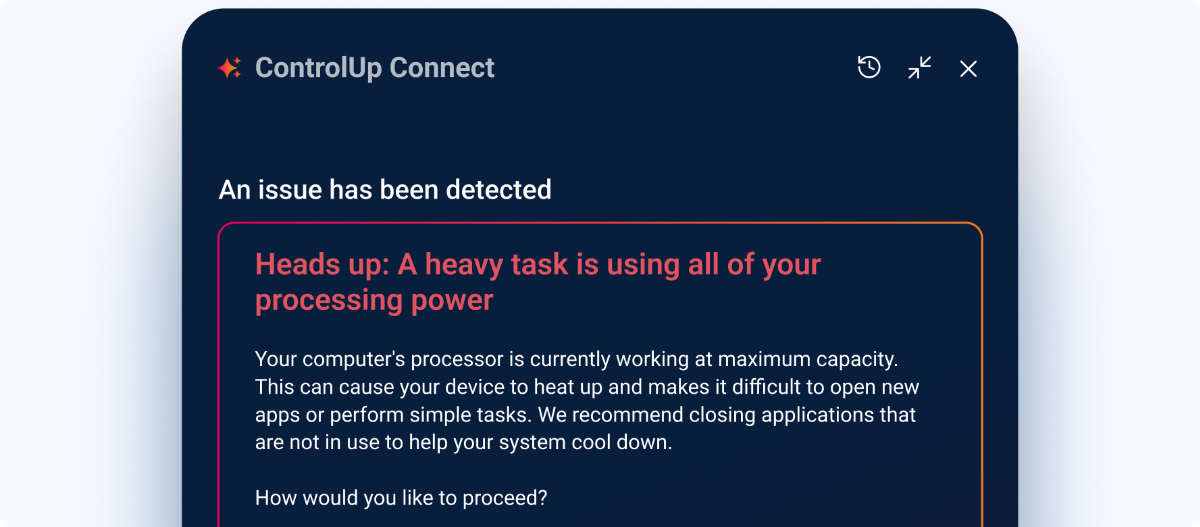 The good news: The AEM can handle it. By introducing AI-powered IT, it can reset spooler services and reinstall drivers for the affected printers. The AEM can also confirm when print jobs are successful to ensure its solutions worked.
The Evolution of Digital Employee Experience Software
An AEM introduces new levels of convenience for employees. It also collects data and then uses it to enhance their experiences.How AEM Enhances DEX
AEM’s mission during the DEX (digital employee experience journey) is straightforward: Make sure all devices and apps perform reliably.Every workflow has priorities—tasks that are more important to employees than others. An AEM understands this and can take action to provide employees with the best possible experience.
Returning to the banking example, customer service employees may need to execute transactions while on the phone with customers. They understand the person on the other end of the line has interrupted their day, doesn’t have much time, and wants a resolution ASAP.
No problem. The AEM gets it! It ensures that each transaction the customer service rep performs for callers receives priority in the network. It also suppresses non-critical background tasks to make sure each task has the bandwidth and throughput it needs.
Callers are happy, and so are the employees helping them.

How AEM Monitors and Responds to Employee Feedback
Which tools are your employees using the most? Which takes the longest to log into, and which gets the best user experience scores? AEM collects and reports all this data, then acts accordingly.Picture a manufacturer with its own internal app that manages the production workflow. Once every few days, the app asks users to rate its performance. Employees from the assembly line, quality assurance, inventory, and management all submit scores.
Rather than waiting on IT to investigate, the AEM turns that feedback into action:
- Analyze the scores to detect patterns.
- Pinpoint lower scores and identify the systems that those employees use.
- Figure out why the system is underperforming, such as due to slow processing times or inaccurate data from faulty integrations with IoT devices.
- Fix the problem or, if there’s a hardware issue, tell IT what the root cause is and how to address it.

Benefits of Autonomous IT in the Workplace
Autonomous IT operations enable employees to work longer without unnecessary interruptions. It also takes many repetitive, time-consuming tasks off the plates of IT team members.In practice, the advantages are palpable:
- Employees don’t have to spend hours troubleshooting devices and skulking back to IT every time there’s a problem.
- IT staff can spend most of the day focusing on strategic improvements rather than putting out small yet incessant fires.
- Customers don’t have to deal with constant outages that eat up time or prevent transactions.
Operational Efficiency and Cost Reduction
An AEM platform consolidates tools and automates workflows. This makes IT’s job simpler and easier, not to mention far more efficient.A business often has several tools for end-user experience monitoring and for checking its systems and devices, with each reporting data to a different dashboard. With AEM, you centralize your device and system management using a single solution.
At a glance, IT can see vital performance stats and the remediation steps AEM has taken to fix problems.

Reducing Downtime through Predictive Maintenance
AEM prevents system crashes by predicting and addressing problems before they plague your workflows.That outage that sent the billing department back to the stone age of pen and paper for a day? AEM could’ve seen that coming.
Those data center delays that sent online customers to competitors during the holiday season last year? AEM could’ve predicted the data transfer issues weeks in advance.
These capabilities are already reshaping IT operations — and the next wave of AEM innovation will push even further.
Future Trends in AEM and DEX
The future of AEM in DEX and DEX software will be powered by:- The rise of AI for IT solutions. AI will enable deeper automations, drastically reducing the need for time-consuming human oversight.
- Deeper integrations in AEM solutions. As more systems integrate with AEM systems, it will be able to seamlessly execute tasks that used to take humans many hours across a wide swath of the operational environment.
- DEX is evolving into the most important KPI across industries. As AEM introduces more frictionless experiences, DEX expectations will rise as well. DEX will become a primary metric, one that determines not just employee turnover but also general organizational success.
- Deeper IT self-service portal options. With the help of an AEM system, employees will be able to perform many tasks that previously fell into IT’s inbox.
ControlUp ONE
The AI-Powered DEX Platform
 ControlUp ONE brings together everything modern IT teams need to move from reactive to autonomous operations. Built around high-frequency telemetry and end-to-end visibility, it covers endpoints, VDI/DaaS, SaaS, UC applications, and frontline mobile devices … all through a single operational layer.
At the center of it all is Pulse AI, ControlUp’s agentic AI engine. It correlates signals across your environment, accelerates root cause analysis, and powers no-code automated workflows that resolve issues before employees ever feel them. Instead of managing tool sprawl and chasing alerts, IT teams get clear, prioritized guidance and autonomous remediations that run quietly in the background.
Fewer disruptions, smarter decisions, lower costs, and a consistently better digital employee experience at scale, across every workspace you support.
Ready to see AEM in action? Take an interactive tour!
ControlUp ONE is purpose-built to orchestrate Autonomous Endpoint Management for organizations of every size and complexity.
Case Studies: AEM Success Stories
ControlUp is at the forefront of AEM. ControlUp automates the routine, so IT can innovate the environment. Here are some examples.
NC State Employees’ Credit Union Saves Time and Resources
North Carolina State Employees’ Credit Union (NC SECU) has more than 400 virtual servers for upwards of 4,800 concurrent end users. Understanding performance across that environment isn’t easy, especially with so many alerts streaming in on a constant basis.Another challenge is performing maintenance tasks. Executing scripts on multiple computers, for instance, can be extremely time-consuming.
But NC SECU uses ControlUp, which:
- Surfaces baselines of normal behavior, making it easier to spot problems
- Indicates early symptoms of failure in servers
- Identifies load-balancing problems
NC SECU also uses ControlUp to catch problems that they otherwise wouldn’t even know are happening. In this way, they stay a step ahead of outages, protecting their most important workflows.
Aveniq Introduces Scalability and Reduces Manual Tasks
Aveniq, a managed services provider whose name means “future” and “IQ,” needed a solution of its own that was futuristic and smart. After a merger, the IT team was stuck with a legacy IT monitoring tool and a clunky product development and synthetic testing system.Instead of rebuilding their entire system from the ground up, Aveniq went with ControlUp.They use it to map needs—both those of customers and their own—and implement new functions.
As a result, Aveniq has significantly reduced the number of manual tasks. As Patrik Vogtlin explains, “The big benefits for us are time savings because ControlUp relieves us of many repetitive tasks.”
Aveniq also uses ControlUp to turn data from user sessions and workloads into infrastructure improvement strategies. In this way, ControlUp gives Aveniq data-backed flexibility for its digital workspace. The team can make smart adjustments using actionable, verifiable data.
Autonomous Endpoint Management for Advanced DEX Optimization
Autonomous, unified endpoint management is the tech arm of a cultural shift in IT. Moving from reactive to proactive IT and from manual to automated solutions will continue to reshape IT workflows.ControlUp is leading the movement. Its agentic AI gives valuable DEX insights, resulting in a centralized, integrated, intelligent platform. Less friction equals greater operational efficiency in IT, not to mention peace of mind for teams.
Learn how ControlUp can empower your IT team to do more by scheduling a free demo.





 English English
  Deutsch
 Français