

Walk into any modern IT Operations Center, and you will see massive screens filled with dashboards. You’ll see rows of green lights indicating healthy servers, 99.9% network uptime, and low CPU utilization across your VDI environment.
Based on this data, your digital transformation investment is a resounding success.
Yet, if you walk out onto the floor (or join a Slack channel), you hear a different story. You hear about applications that lag during critical customer calls, logins that take long enough to grab a coffee, and the general digital friction that bleeds productivity out of the workday.
This is the “Experience Gap.” It is the chasm between what IT monitoring tools say is happening and what your employees actually feel while working.
For the C-Suite, bridging this gap is no longer just an IT operational issue; it is a strategic imperative tied directly to retention, productivity, and ROI.
The Illusion of the “Healthy” System
Traditional IT monitoring was built for infrastructure, not for people. It asks: “Is the server on?” It rarely asks: “Can the employee do their job efficiently?”
A laptop might look technically healthy on a dashboard because resource consumption is low. But why is it low? Perhaps because the user is stuck staring at a frozen screen, unable to work. The dashboard sees stability; the employee experiences failure.
When IT relies solely on hard metrics, they are managing the infrastructure, not the business outcome. This leads to “watermelon status” green on the outside (the dashboard), but red on the inside (employee sentiment).
Enter Digital Employee Experience (DEX)
To fix this, forward-thinking organizations are shifting focus to Digital Employee Experience (DEX). DEX platforms, like ControlUp, acknowledge that the human element is a critical data point in the IT ecosystem.
ControlUp goes beyond monitoring device performance; it integrates Employee Sentiment directly alongside technical metrics.
This isn’t about sending another exhaustive, annual HR survey that gets ignored. It’s about capturing micro-feedback contextually, right in the flow of work.

How it works in practice:
Instead of guessing why ticket volume is up, IT can set automated triggers.
- The Scenario: An employee just finished a Zoom call where the jitter was high.
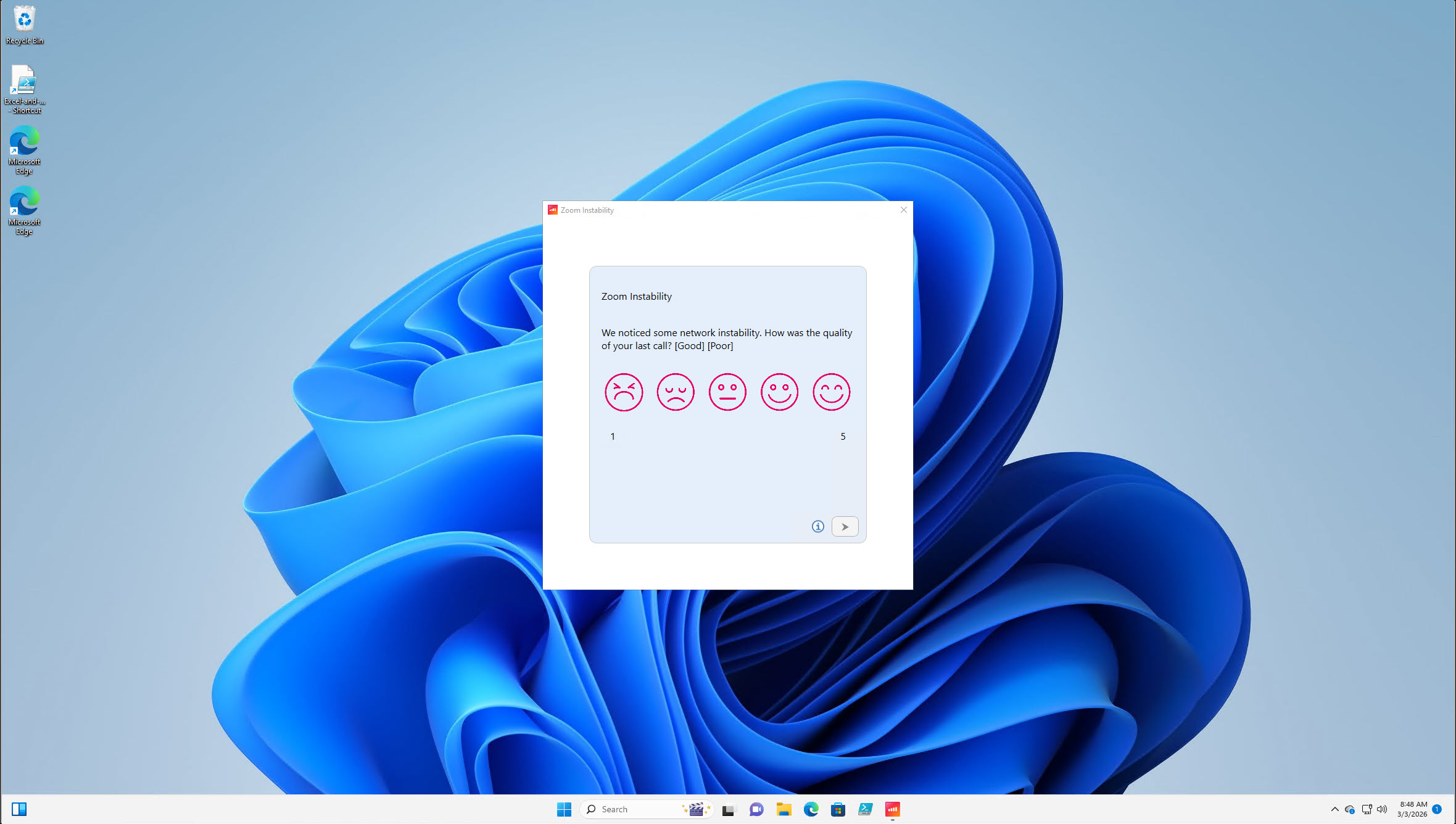
- The Action: ControlUp detects the end of the call and immediately presents a subtle, non-intrusive notification: “We noticed some network instability. How was the quality of your last call? [Good] [Poor]”
- The Insight: IT now has a direct correlation between network data at 10:03 AM and a “Poor” rating from a specific user.
The Strategic ROI of Measuring Sentiment
For executive leadership, integrating employee sentiment into IT strategy delivers measurable business value:
- Aligning IT Spend with Business Reality: You spend millions on hardware refresh and software upgrades. How do you know they worked? Don’t just measure if the deployment was successful; measure if employee satisfaction improved post-deployment. Sentiment data validates the ROI of your IT initiatives.
- Moving from Reactive to Proactive: “Invisible friction” rarely results in a help desk ticket. Employees just suffer in silence, reboot their machines, or find insecure workarounds (Shadow IT). By pulse-checking sentiment, IT can identify widespread frustrations before they become major incidents or attrition risks.
- Prioritizing What Actually Matters: Your IT team has limited resources. Should they fix the server issue that affects 2% of users, or the login delay that frustrates 80% of the sales team every morning? Sentiment data cuts through the noise, helping IT prioritize the fixes that will have the biggest impact on business productivity.
- The Talent War Driver: In a competitive market, your technology stack is essential to the employee value proposition. Top talent will not tolerate subpar digital experiences that prevent them from performing. A frictionless digital environment is a retention tool.
The Conclusion
You cannot manage what you do not measure. For decades, we have meticulously measured our machines. It is time we start measuring the experience of the people using them. By combining hard technical data with human sentiment, you move IT from a cost center maintaining infrastructure to a strategic partner optimizing workforce performance. Your dashboards might be green, but until your employees agree, the job isn’t done.
