Traditional endpoint management is failing to keep pace with hybrid work, SaaS proliferation, and business velocity, necessitating a shift to a new, more autonomous IT operations model.
- The limitations of legacy systems result in eroded employee experience, perpetual reactive IT operations, and inefficient tool sprawl that cannot scale effectively.
- Autonomous Endpoint Management (AEM), leveraging agentic AI, provides a solution by autonomously detecting and resolving IT issues in real time, consolidating various functionalities.
- Adopting AEM transforms IT from a reactive "fixer" to a proactive "builder," ensuring a consistently functional digital workspace and preventing operational challenges from escalating into critical business problems.
It’s Monday morning. Three employees are locked out of their virtual desktops. A SaaS app that half the sales team relies on is throwing errors no one can explain. The helpdesk queue is already twelve tickets deep, and your most experienced engineer is buried in a manual patch cycle that should’ve been automated two years ago.
Sound familiar?
If you’re an IT leader at a growing organization, this is sadly the baseline and not just a bad week. And the unsettling truth is that the tools most IT teams are leaning on to manage these situations weren’t built for this world. They were built for a different one.
The problem isn’t your team; it’s the architecture underneath them.
The Old Model Made Sense… Once
To be fair, traditional endpoint management tools were never bad. Unified endpoint management (UEM) platforms, siloed monitoring solutions, and manual patch cycles were engineered for a world that was mostly predictable. Devices sat on a corporate network. Employees sat in an office. Change happened slowly enough that reactive troubleshooting was a viable operating model.
In that world, “if it ain’t broke, don’t fix it” was a reasonable IT strategy. And for a long time, it held up.
But that world is gone.
Three Forces That Broke Traditional Endpoint Management
The shift didn’t happen all at once, but three converging forces have made legacy endpoint management structurally obsolete. And, together, they’ve created what might be called the scalability gap.
1. Hybrid Work at Scale
Endpoints are no longer neatly contained within a corporate perimeter. They’re connecting from kitchen tables, coffee shops, co-working spaces, and hotel lobbies — on unpredictable networks, often invisible to traditional monitoring tools. Managing a device fleet that’s geographically distributed and constantly in motion is fundamentally different from managing one that sits behind a firewall.
2. The SaaS Explosion
The average enterprise now runs hundreds of SaaS applications. Each one is a potential point of failure. Each one generates signals. And most traditional endpoint tools weren’t built to monitor, correlate, or remediate across a stack this dynamic. When something breaks, IT teams are left stitching together data from five different dashboards to troubleshoot SaaS apps, hoping the answer reveals itself before the helpdesk collapses.
3. The Velocity Gap
This is the one that doesn’t get talked about enough. Businesses move fast. Teams scale overnight. New tools get adopted in days, sometimes hours. Meanwhile, traditional endpoint infrastructure changes slowly by design. The gap between the pace of business growth and the pace of IT infrastructure creates constant drag: friction for employees, firefighting for IT, and mounting technical debt for everyone.
→ See “The Impact of Disruptions: The Path to Autonomous IT”
The Real Cost: This Isn’t Just an IT Problem
Here’s where IT leaders need to reframe the conversation, especially with business stakeholders who see endpoint management as a back-office concern.
The cost of a broken endpoint model doesn’t stay in the IT department. It spreads.
Employee Experience Erodes
A remote worker who can’t get a tool working has no IT desk to walk to. They wait, lose time, and quickly get frustrated. Over time, that friction compounds into disengagement — and disengagement is a business problem that shows up in attrition numbers, not helpdesk tickets. This is precisely why digital employee experience (DEX) has moved from an IT metric to a C-suite priority.
IT Gets Trapped in Reactive Mode
When your best engineers spend their days responding to tickets and running manual remediation, they’re not building the infrastructure and shaping the AI initiatives that support next quarter’s growth. Strategic work never happens because operational work never stops.
Tool Sprawl Drives Cost Without Clarity
Most enterprises have accumulated a patchwork of overlapping endpoint tools: monitoring here, patching there, compliance tracking somewhere else. These tools rarely talk to each other. The result is redundant costs, coverage gaps, and an IT team spending more time managing tools than managing outcomes.
And as the organization grows? None of this can scale linearly. The complexity only accelerates.
→ Watch CIO Solutions share their tool consolidation success story
→ Check out this blog about conquering SaaS sprawl to save budget
Autonomous Endpoint Management is a Different Category of Solution
The response to this isn’t a better version of the old tools. It’s a fundamentally different model… one that’s increasingly being defined as Autonomous Endpoint Management (AEM).
AEM isn’t just a product category. It’s a real shift in how IT operations work. Instead of systems that alert humans to problems and wait for a response, AEM platforms like ControlUp ONE use agentic AI to act on those signals autonomously — closing the loop between visibility and remediation in real time.
Here’s what that looks like in practice:
From Alerting to Acting
Traditional IT monitoring tells you something is wrong. An AEM platform identifies the issue, correlates it against real-time environment data, and resolves it (often before the affected employee even notices). That’s the difference between end-user experience monitoring that surfaces problems and a self-healing environment that eliminates them.
AI That Executes, Not Only Advises
The “agentic” part of agentic AI matters. It’s not a chatbot recommending a fix. It’s an AI layer that takes autonomous action within defined parameters. That includes running automated root-cause analysis, triggering remediations, and learning from outcomes to improve over time.
→ Read more about moving from tickets to autonomy with an AI-driven IT helpdesk
DEX as a Signal Layer vs. An Afterthought
When digital employee experience tools are integrated into the endpoint management platform — not bolted on separately — IT teams get a continuous, real-time view of how technology is performing for the people using it. Endpoint health and employee experience stop being separate metrics and start being one feedback loop.
Consolidation Over Complexity
AEM platforms are built to replace the patchwork, not add to it. A single intelligent flow handles monitoring, remediation, compliance, and experience, with data that connects across the environment rather than sitting in silos.
→ Explore “Modern Endpoint Management with Microsoft Intune and DEX”
What IT Looks Like When It Actually Scales
The organizations moving toward autonomous IT operations aren’t doing it because they have bigger budgets. They’re doing it because they’ve recognized that the reactive model has a ceiling and they’re hitting it.
→ “The CIO’s Guide to Autonomous IT” covers this in detail
When the endpoint environment runs autonomously, IT teams stop being the people who fix things and become the people who build them. Proactive IT becomes possible not as an aspiration, but as an operational reality. Employees get a digital workspace that works consistently, regardless of where they’re connecting from or which tools they’re using.
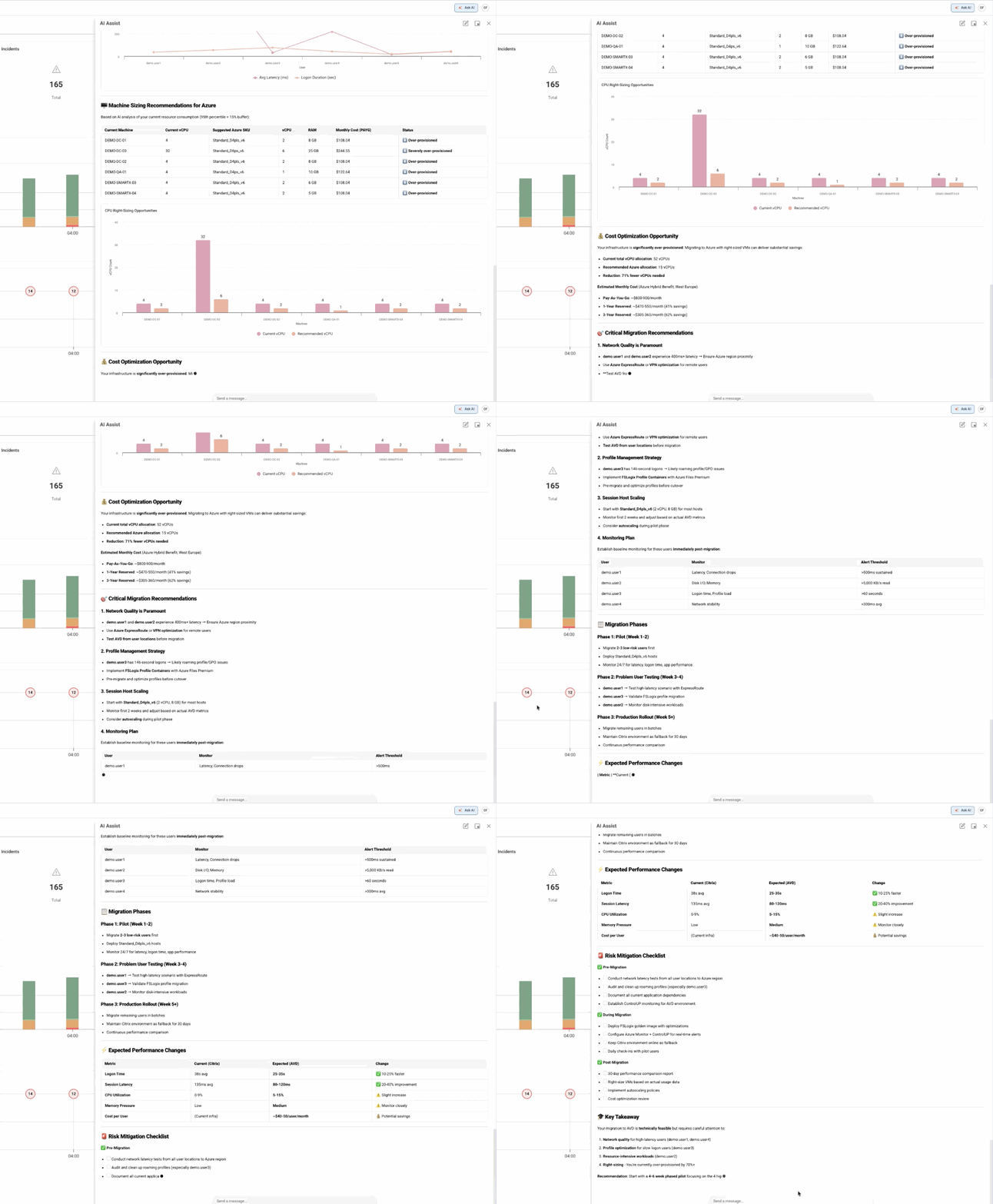
That’s not a distant future state. It’s what AI in IT operations is enabling right now, for teams willing to move beyond the comfort of legacy infrastructure.
The Question Worth Asking
The question isn’t whether traditional endpoint management will eventually fail to keep up with your business. At the pace at which hybrid work, SaaS adoption, and organizational complexity are evolving, it’s likely already the case.
The real question is whether your IT strategy will adapt before that gap becomes a business problem you can’t quietly contain. For IT leaders ready to explore what autonomous endpoint management looks like in practice, ControlUp is built exactly for this moment.
And if you’re still evaluating where AI fits into your IT operations strategy, the AI-Powered IT Self-Service and AI Assistant capabilities are a useful place to start.
