CHRISTUS Health
From Days to Hours: How CHRISTUS Health Automated Root-Cause Analysis and Remediated 900 Devices with ControlUp’s Pulse AI Insights

Employees: ~50,000
Industry: Healthcare
Environment: Enterprise-scale end-user computing and VDI environment
Key Integrations/Platforms: ServiceNow, Microsoft SCCM, VDI, Dell endpoints
- Turning data into understanding: Extensive endpoint telemetry provided visibility, but investigating patterns and determining root causes still required significant engineering effort
- Time-consuming crash analysis: Application crashes could require a day or more of manual research to determine scope, impact, and cause
- Enterprise-scale troubleshooting: Issues affecting hundreds of devices could be difficult to recognize when investigating individual endpoints and events
- Service desk visibility: Analysts needed immediate insight into device performance and the impact of troubleshooting actions
- Different needs across IT teams: Service desk, engineering, leadership, VDI, and higher-tier analysts required different levels of visibility and access
- ControlUp ONE platform
- Pulse AI Insights
- Faster root-cause analysis: Reduced application-crash investigations that could take a day or several days of manual work to identify within hours.
- 900 devices remediated: Identified an audio driver issue affecting approximately 900 endpoints and provided evidence and recommended remediation
- More efficient service desk operations: Gives analysts real-time visibility into device performance while actively troubleshooting
- Actionable intelligence: Connects data across the environment to identify patterns, root causes, affected devices and recommended actions.
- Broader IT visibility: Dashboards, reports, and real-time telemetry support service desk, engineering, VDI, analyst, and leadership use cases
- 100+ ControlUp users: Adoption expanded from a handful of users to more than 100 across CHRISTUS Health
CHRISTUS Health is an international Catholic, not-for-profit health system headquartered in Irving, Texas. One of the largest health systems in the U.S., CHRISTUS includes more than 60 hospitals and hundreds of other care locations, with operations spanning Texas, Louisiana, New Mexico and Arkansas, as well as Mexico, Colombia and Chile. Its workforce includes more than 50,000 associates supporting care across this geographically distributed organization.
CHRISTUS Health’s technology environment spans physical endpoints, virtual desktops, enterprise applications and supporting infrastructure. More than 100 IT professionals across service desk, engineering, leadership and other teams now use ControlUp for use cases ranging from real-time endpoint monitoring and troubleshooting to dashboards, reporting, anomaly detection and VDI performance analysis.
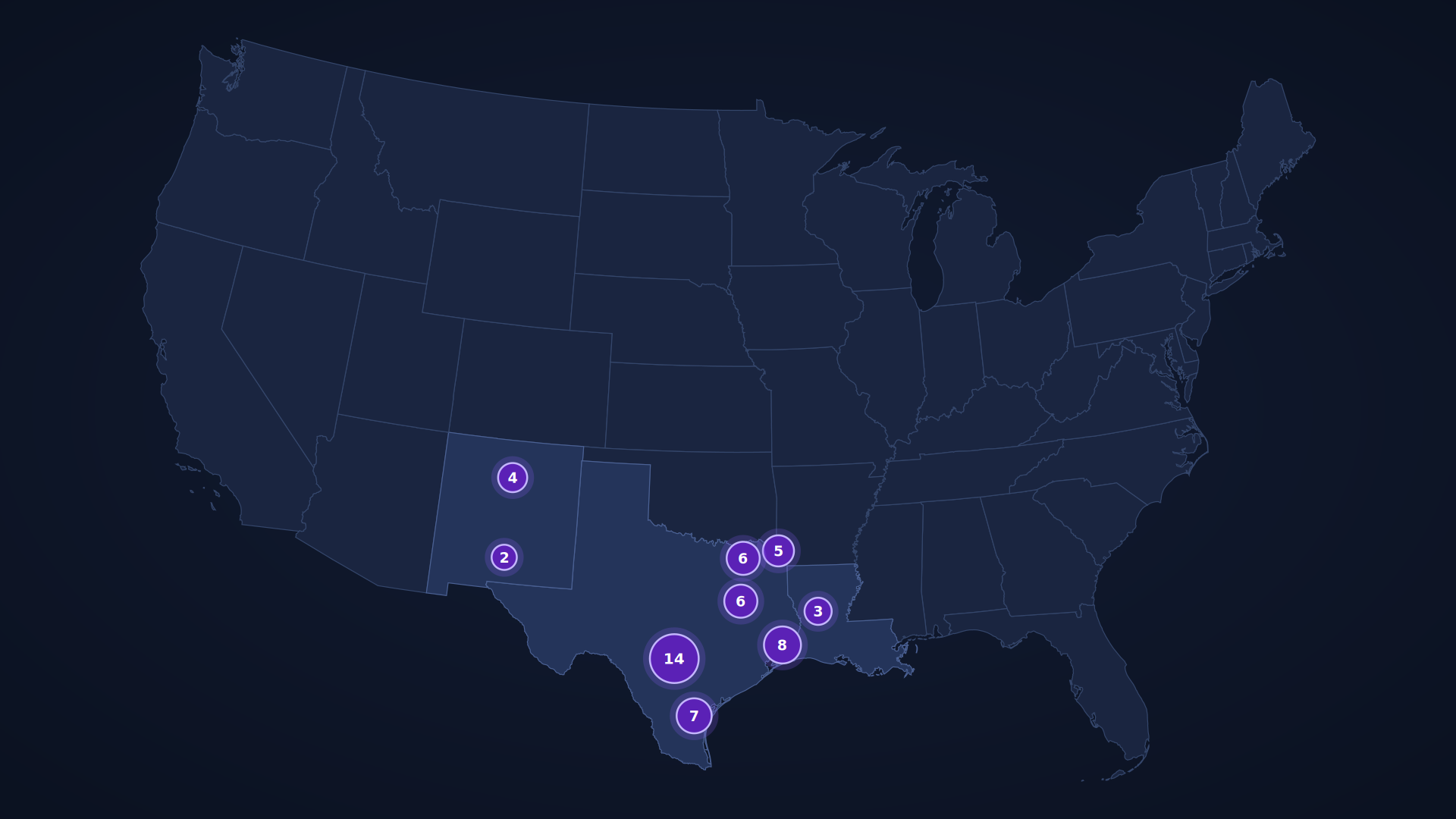
US map showing CHRISTUS Health facility location
The Challenge
CHRISTUS Health already had extensive endpoint data available through ControlUp. The challenge was turning that volume of information into a clear understanding of what was happening across the environment and where IT teams should focus their attention.
Application crashes illustrate the problem. Investigating a recurring crash meant digging into individual events and devices, determining how widespread the issue was, searching for common factors, identifying the root cause, and then developing and validating a potential fix.
For Kaleb Smith, Information Technology Engineer at CHRISTUS Health focused on end-user computing, simply researching an application crash and determining its impact could take approximately a day. Identifying the problem and developing a remediation could stretch into several days.
“We have all the data, but just looking into the app crashes and then diving down to say, ‘Okay, what’s the real impact? Is there a problem?’ would take me a day or so to really do some research on what’s going on and what’s the impact,” said Smith.
The Solution
ControlUp provides CHRISTUS Health with real-time and historical visibility across its end-user computing environment, supporting different workflows for service desk analysts, engineers, leadership, VDI teams and higher-tier analysts. Service desk teams can inspect endpoint performance while actively troubleshooting, while engineering and leadership teams use dashboards, reporting and anomaly detection to understand device health and trends across the organization.
Pulse Insights builds on that visibility by helping CHRISTUS Health interpret the endpoint data it is already collecting. Rather than simply detecting an individual issue, Pulse Insights analyzes data across the environment to identify patterns and relationships that can be difficult and time-consuming for engineers to uncover manually. By correlating signals across applications, devices and other endpoint activity, it can surface meaningful issues and give the team a clearer starting point for investigation. For CHRISTUS Health, Pulse Insights turns broad endpoint data into a more focused starting point for investigation. It can surface meaningful patterns, identify affected endpoints, provide evidence supporting the root cause and recommend potential remediation. While application crashes are one example of this capability, Insights can analyze signals across the environment to uncover relationships that might otherwise be difficult to recognize.
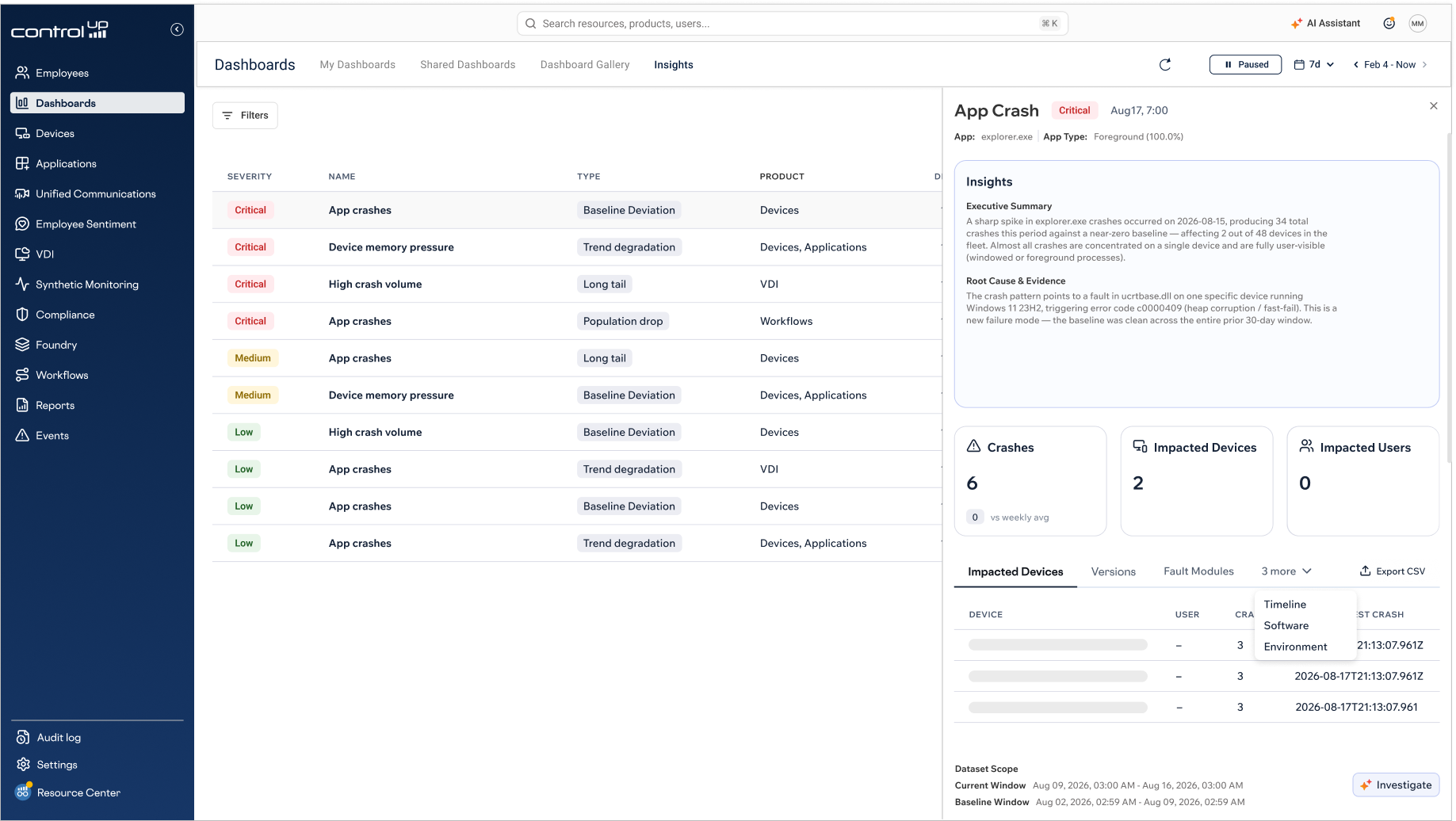
ControlUp Pulse Insights Example
“Pulse Insights is great because I have this tool that just says, ‘Hey, there’s this app crash in your environment. There’s this many devices. Here’s the root cause and the evidence supporting that, and here’s what we would recommend as remediation,’” said Smith.
A recurring Dell audio driver issue demonstrated the difference. Pulse Insights identified crashes involving the driver across approximately 900 devices and recommended a driver update or escalation to the OEM. The CHRISTUS Health team tested the recommendation on several affected devices using Dell Command Update. When the newer driver stopped the crashes, the team could deploy the update across the remaining affected devices.
The investigation also showed why the crashes mattered. The driver problem was causing related audio applications to freeze and affecting dictation microphones. Without Pulse Insights correlating the activity across the environment, the issue could have continued in the background without its broader impact being apparent.
Instead of manually moving from individual events to pattern recognition to root-cause analysis, Pulse Insights helped CHRISTUS Health move more directly from detection to correlation to understanding to action. Just as importantly, it continuously analyzes the environment for issues worth investigating, reducing the burden on engineers to discover those patterns themselves.
The Result
For CHRISTUS Health, the value of ControlUp increasingly comes from moving beyond visibility alone.
With Pulse Insights, application-crash investigations that could previously consume a day or several days of engineering effort can be surfaced and understood much faster. Instead of manually examining disconnected events, engineers can start with an identified pattern, understand the affected devices and likely root cause, review supporting evidence, and evaluate a recommended remediation. The value is in identifying meaningful patterns across the environment and giving engineers a clear starting point for investigation and remediation.
The Dell audio driver incident demonstrated that value at enterprise scale. Pulse Insights identified the pattern across approximately 900 devices, giving the team a starting point for testing and remediation before the issue required engineers to manually connect hundreds of individual signals. By continuously looking across the environment for those relationships, Pulse Insights can reduce the time engineers spend searching for problems and allow them to focus more quickly on validation and remediation.
The result is not simply faster detection. It is a more efficient path from visibility to understanding to action.
ControlUp is also helping CHRISTUS Health extend that approach across IT operations. Beyond Pulse Insights, service desk analysts gain immediate visibility into endpoint health while troubleshooting. Engineering teams can investigate trends and anomalies across longer periods. Leadership can use dashboards to understand device health across the organization, and VDI teams can examine session, connection, and login performance.
As more teams have discovered those use cases, adoption has expanded from a handful of ControlUp users to more than 100. CHRISTUS Health manages that access through a customized role-based model using Active Directory security groups, standard and privileged accounts, and approximately 33 to 35 roles that determine what different teams can see and what actions they can perform.
For Smith, demonstrating the value of ControlUp often starts not with an ROI calculation, but with a practical question: How are you doing this today? Showing teams a faster or more direct way to answer an existing operational question has helped expand adoption throughout the organization.
As CHRISTUS Health continues to find new use cases for ControlUp, Smith sees the platform’s value in its ability to address practical needs across IT teams and make that value immediately apparent to users.