
Pulse AI Resolve, ControlUp's new AI-native self-service and remediation hub, automates IT support directly on employee endpoints to proactively resolve issues and reduce support tickets.
* This solution monitors device performance, diagnoses problems, and provides guided, real-time fixes utilizing an automated four-level support model, including agentic AI.
* Pulse Resolve features robust governance with layered security, organizational policy enforcement, and role-based access control to ensure secure and approved remediation actions.
* It empowers employees with immediate issue resolution, thereby reducing the IT support burden and improving overall operational efficiency.
Every IT team knows the pattern: five tickets arrive in one afternoon about the same app freezing, but the shared root cause becomes clear only after the fifth. Tickets often lack the technical context needed for action, forcing IT to investigate before resolving the issue. Meanwhile, employees may wait until the problem becomes severe—or give up and work around it.
Today we’re announcing a major update Pulse AI Resolve (formerly ControlUp Connect), ControlUp’s AI-native self-service and remediation hub, built directly into the endpoint.
What Pulse Resolve Does
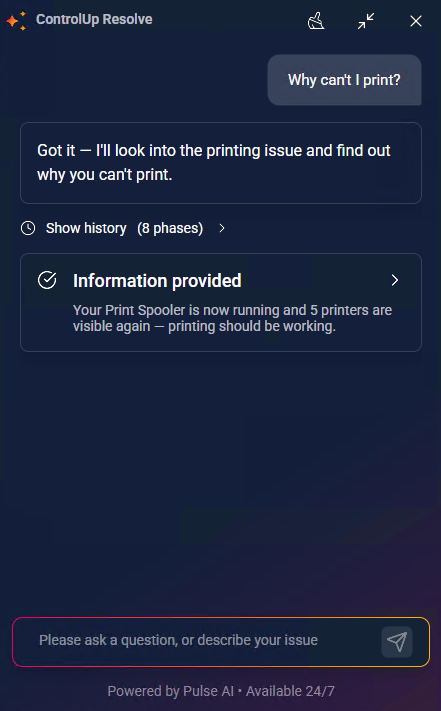
Pulse Resolve lives on employees’ devices and connects to the ControlUp ONE platform and Pulse AI engine. It continuously monitors performance, catches anomalies early, and guides employees to fast, clear fixes, in plain language, without the back-and-forth of a traditional support ticket. When it detects an issue, it initiates a chat, investigates, diagnoses, and remediates in real time, keeping the employee informed and asking for consent throughout.
The result: Pulse Resolve reduces tickets by empowering employees to solve issues themselves. It’s built on the same four-level support model IT already knows and trusts, just automated at every step.
How It Works: Four Levels, All Automated
Pulse Resolve mirrors the support ladder IT teams have relied on for 20 years. It just uses automation to notice, triage, and act.
- Level 0, Self-Service: Employees get instant fixes from a library of pre-approved, IT-configured remediations. No ticket, no wait.
- Level 1, Pattern Matching: Recurring issues are recognized and resolved automatically, the work a first-line technician used to do by hand, now done the moment the issue appears.
- Level 2, Built Actions: A library of built-in and custom actions gives IT the building blocks to assemble new skills for issues Pulse Resolve hasn’t encountered yet.
- Level 3, Agentic AI: For the hardest issues, agentic AI reasons through a resolution automatically, always operating inside the approval rules IT defines.
- Human Handoff: When Pulse Resolve can’t close the loop itself, it hands off to an IT support technician with full context already attached.
Autonomous, But Governed
An AI agent that can act on an endpoint raises an obvious question: what stops it from doing something you didn’t approve? Pulse Resolve is built around a straightforward answer: every autonomy claim comes paired with a governance claim.
Protection is layered across the whole request. Built-in platform guardrails catch unsafe asks, like privilege escalation, before investigation even starts. An NVIDIA NeMo Guardrails execution gate checks any proposed action for dangerous patterns immediately before it touches a device. And the organization’s own policies, written in plain business language rather than code, are enforced through a curated library or fully custom rules.
Role-based access control decides who can approve a mitigation versus just investigate. Admins can require separate approvals for diagnostics versus fixes, and for actions in the user’s context versus the system context. Organizations can even confine Pulse Resolve to a vetted set of patterns only: when nothing approved matches an incident, it stops and tells the employee to contact IT rather than improvising.
And it’s private by design. Diagnostic analysis happens locally on the device, gathering only the targeted, time-bounded data needed for the finding and nothing more.
Update Available Today
Pulse Resolve’s self-service chat, proactive detection, autonomous remediation, and automatic ITSM ticket creation (with ServiceNow) are live now, alongside RBAC controls and notification governance. Enterprise design partners including Teleperformance, Principal, and Houlihan Lokey are piloting Pulse Resolve today as part of a phased rollout.
See It in Action
Pulse Resolve is available now to ControlUp customers as part of the Pulse AI engine, alongside Pulse Insights and Pulse Assist. Reach out to your ControlUp representative to see it live.
