
ControlUp’s AI platform builds on leading Digital Employee Experience (DEX) capabilities. It redefines IT operations by moving beyond passive monitoring to enabling intelligent, real-time, and autonomous remediation. Employee issues are resolved proactively before they reduce productivity.
The platform is built on a foundational architecture of continuous, 3-second live edge telemetry, providing the real-time data essential for immediate issue detection and action.
Pulse AI leverages this real-time data for anomaly detection, LLM-based root cause analysis, and autonomous remediation workflows, resolving problems before employees even notice them.
ControlUp integrates native remote management and aims for Autonomous Endpoint Management (AEM), where the system anticipates, learns, and self-optimizes, enabling IT teams to focus on strategic initiatives rather than reactive support.
In the era of autonomous IT, monitoring without remediation is just an expensive dashboard. Here is how a new generation of DEX architecture changes everything.
For years, IT teams were told that visibility was the goal. Monitor everything, alert on thresholds, and let humans handle the rest. That model is broken and your employees feel it every single day.
The shift to hybrid work exposed a hard truth: the gap between “we see an issue” and “the issue is fixed” is where productivity goes to die. An employee with a sluggish device, a crashing SaaS app, or a degraded network connection does not need a ticket number. They need their problem solved in the next five minutes, not the next five business hours.
This is the core challenge that modern AI and Digital Employee Experience (DEX) platforms must answer. And the answer is not more dashboards. It is intelligent, autonomous action.
Real-Time Means Every Three Seconds, Not Every Five Minutes
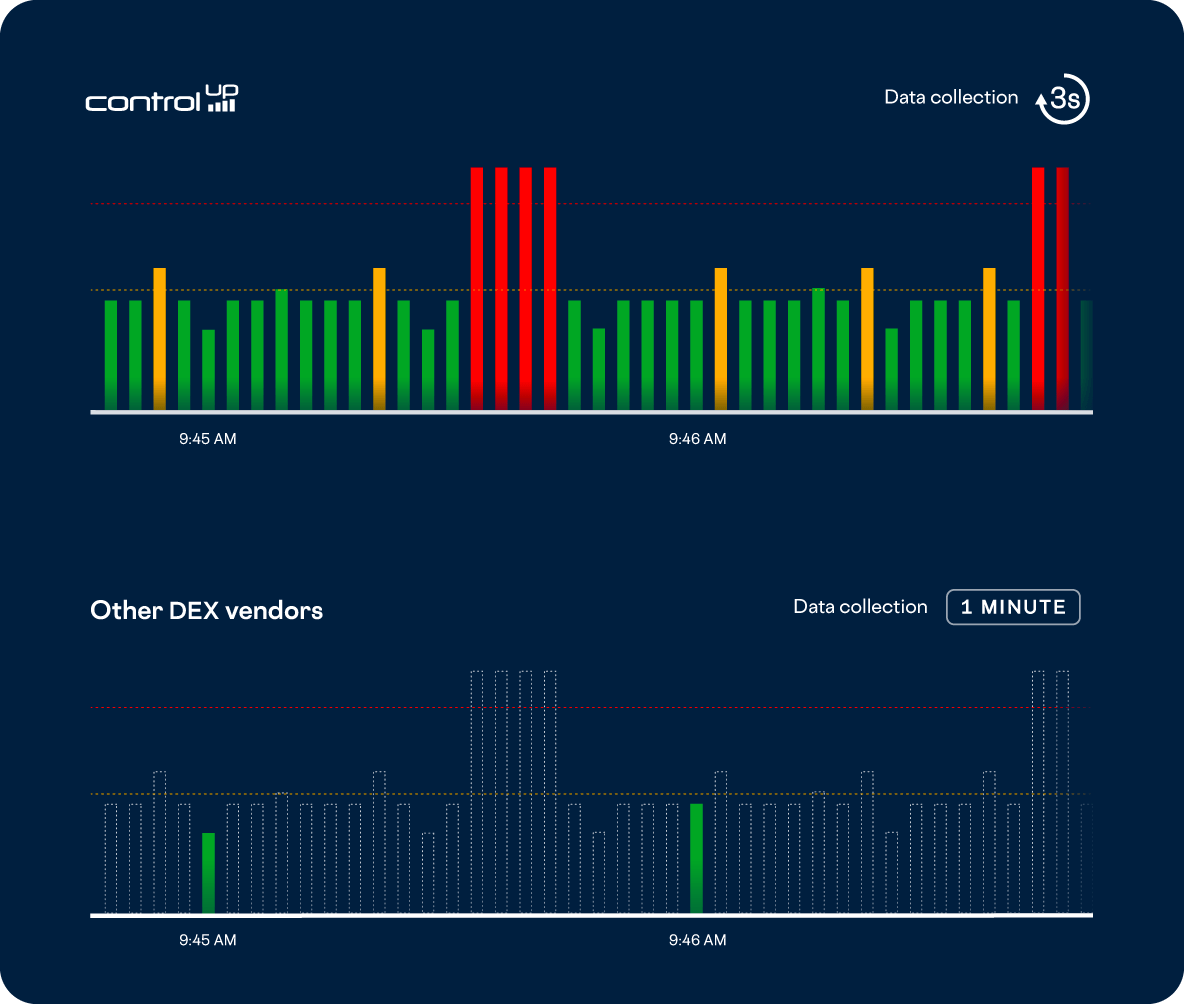
The debate in DEX is not whether you should collect telemetry. Everyone does. The question is: how stale is your data when you act on it? Polling-based architectures, where agents check in on a schedule and batch their results, introduce latency that is invisible on paper but devastating in practice. A user’s machine can spike to 100% CPU, crash a critical application, and partially recover before a polling-based system even registers the event.
ControlUp was built differently from the ground up. Live edge telemetry streams continuously, updating every three seconds across thousands of signals per endpoint. This is not a marketing figure. It is the architectural foundation that makes proactive remediation possible. You cannot fix what you cannot see in real time.
That three-second heartbeat is what separates a monitoring tool from a management platform. It is the difference between a smoke detector and a sprinkler system.
Live Telemetry Interval: 3 seconds | Metrics Per Endpoint: 2,000+ | 80% of tickets stem from the same 20% of issues
The AI Should Find the Problem Before the Employee Does
Survey-based sentiment collection has a fundamental flaw: it requires someone to already be frustrated. By the time an employee stops what they are doing, opens a survey, and rates their experience a three out of five, you have already lost the productivity battle. Worse, survey fatigue sets in fast. Response rates drop, the data gets skewed toward the most annoyed users, and you end up with a metric that reflects vocal dissatisfaction rather than actual system reality.
ControlUp’s approach is architecturally different. Pulse AI, the intelligence layer at the heart of the DEX platform, continuously analyzes telemetry to detect anomalies before employees notice them. Rather than asking, “How does this feel?”, Pulse asks, “What is actually happening?”—and acts accordingly.
Pulse uses LLM-based root cause analysis, pattern matching trained on previous investigation outcomes, and risk-scored remediation workflows. It establishes intelligent baselines from historical telemetry, accounting for normal variance patterns like morning login surges, so it can distinguish a real problem from expected noise. This is what true proactive IT looks like: issues caught and resolved before they touch the employee’s awareness.
How Pulse AI Works: Pulse continuously monitors endpoint telemetry, identifies anomaly patterns using AI-driven baselines, and generates remediation recommendations with confidence scores and risk-based approval workflows, all without waiting for a user complaint to trigger the investigation cycle.
Pattern Learning: Every investigation outcome feeds back into Pulse’s pattern-matching engine. The system learns which root causes map to which remediation actions, continuously improving detection accuracy and reducing time-to-resolution with each resolved incident across the entire customer base.
A Score That Reflects What Is Actually Happening
DEX scores have become table stakes in the IT vendor world. But not all scores are created equal. A score derived primarily from user surveys carries a fundamental validity problem: it measures willingness to engage with a survey as much as it measures digital experience quality. Organizations with more engaged, survey-happy workforces will appear to have better DEX than organizations with identical infrastructure performance but lower survey completion rates.
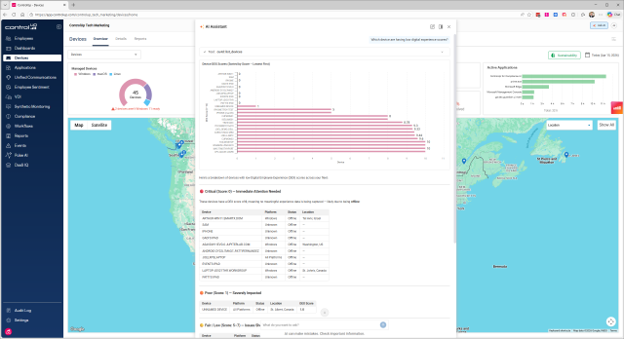
ControlUp’s experience scoring is grounded in hard, objective telemetry: login times, application responsiveness, network latency, CPU and memory pressure, and session performance. These signals do not get tired of being asked. They do not inflate scores for employees who want to seem positive. They reflect system reality, which is exactly what IT teams need to make good decisions.
This distinction matters enormously in practice. When a DEX score drops in ControlUp, you know something actually changed in the environment, not just that a team had a rough Monday morning and vented in the survey tool.
Native Remote Management, No Additional Vendors Required
Here is a conversation IT leaders have more often than they would like: “We have our DEX platform for visibility, but we use a separate RMM tool for remote control, a separate tool for ticketing integration, and a separate tool for SaaS monitoring.” Every additional tool in that stack represents another vendor relationship, another contract, another integration to maintain, and another surface area where data does not quite line up between systems.
ControlUp took a deliberate architectural position: everything needed to manage a digital workspace should live on one platform. ControlUp Live Remote Management, launched in January 2026, brings true real-time visibility and silent remediation to physical endpoints natively, without requiring organizations to procure or integrate a separate remote management solution. IT administrators work from a single console with consistent workflows, standardized metrics, and unified reporting across their entire managed infrastructure.
This is not a feature checklist argument. It is a fundamentally different philosophy about what a DEX platform should be. The consolidation benefit is real: fewer context switches for IT teams, fewer data reconciliation headaches, and a lower total cost of ownership that compounds over time as organizations scale.
From Autonomous Remediation to Autonomous IT Operations
The current generation of DEX platforms is still largely reactive with automation: sophisticated, but still waiting for something to go wrong before taking action. The next phase is what ControlUp calls Autonomous Endpoint Management (AEM): an environment where the IT infrastructure not only detects and remediates issues, but anticipates them, learns from patterns, and optimizes itself continuously without requiring IT teams to build and maintain automation scripts.
ControlUp’s agentic AI framework moves beyond rules-based automation toward a self-learning remediation model, one where IT teams validate outcomes rather than design workflows. Combined with the foundational three-second telemetry cadence and Pulse AI’s pattern recognition, this creates a compounding intelligence flywheel: more signals, better patterns, smarter remediation, and fewer disruptions for employees.
The Self-Service Hub extends this logic all the way to the employee’s desktop. When Pulse AI detects sustained CPU pressure or memory exhaustion, it does not just log the event. It notifies the employee, explains what is happening in plain language, and offers to fix it autonomously. The employee approves the action; the AI executes and validates the fix. For issues that require human IT intervention, a prepopulated ServiceNow ticket is generated automatically, complete with real-time metrics, event logs, and an AI-generated diagnostic summary so Tier 2 support has everything they need on arrival.
This is the vision: a digital workspace that largely runs itself, where IT teams spend their time on strategic work rather than triaging a relentless stream of performance tickets that 80% of the time have the same 20% of root causes.
The DEX market is maturing rapidly, and vendors that built their architectures on polling, surveys, and bolt-on remote tools are finding it increasingly difficult to compete with platforms designed from the ground up for real-time action. IT leaders evaluating their DEX stack in 2026 should be asking one question above all others: When my platform finds a problem, what happens next?
If the answer is an alert goes to the IT team, that is monitoring. If the answer is the system investigates, generates a fix, gets user consent, and resolves it autonomously, that is the future. And the future is already here.
