
 Tom Holland
 Move from reactive treatment to proactive wellness by giving your environment the power to heal itself.
Imagine your body’s response to the common cold. You don’t usually have to consciously tell your white blood cells to attack a virus. You don’t manually raise your internal temperature to fight an infection. Your immune system is a complex, autonomous network of sensors, patrollers, and defenders. It detects threats and neutralizes them, often before you even feel a sniffle.
Now, imagine your IT environment.
For decades, IT operations have functioned like an overwhelmed emergency room waiting room. We wait for the “patient” (an end-user or a server) to show severe symptoms. This could be a blue screen of death, a frozen application, or a loss of connectivity. Then, we scramble to diagnose and treat it fast.
We call this the “break/fix loop.” It’s exhausting, expensive, and it means your employees are suffering downtime before IT even knows there’s a problem.
In the era of complex, distributed workforces, the break/fix model is obsolete. Your infrastructure is too vast and vital to rely on manual intervention for every hiccup.
It’s time to stop just monitoring IT. It’s time to build a ‘Digital Immune System’.
What is a Digital Immune System?
A Digital Immune System is a major shift in IT Operations and Digital Employee Experience (DEX) management. It moves beyond passive observation into the realm of autonomous IT action.
Just like a biological immune system, a digital one is designed to be vigilant, resilient, and self-healing. It doesn’t wait for a help desk ticket to be filed. It proactively detects anomalies—the digital equivalent of pathogens—and automatically deploys countermeasures to restore health before the business is impacted.
At ControlUp, we believe this isn’t science fiction; it’s the necessary evolution of IT operations. Here is the anatomy of how a Digital Immune System works in practice.
The Anatomy of Autonomous IT Health
To build innate immunity into your IT infrastructure, you need three core biological functions translated into technology: The Nervous System, The Antibodies, and The White Blood Cells.
1. The Nervous System: Real-Time, Granular Sensors
You can’t fight what you can’t feel. A biological immune system relies on constant signals from the nervous system to know if something is wrong.
In IT, this is real-time data collection at the edge. Most IT infrastructure monitoring and DEX monitoring tools take “snapshots” every 5 or 15 minutes. That’s too slow. A virus can wreak havoc in that gap. A true Digital Immune System needs continuous, high-frequency sampling of metrics from every endpoint, VDI session, application, and network connection.
You need to feel the “pulse” of the environment second-by-second to detect the subtle deviations that precede a major outage.
2. Antibodies: Intelligent Detection Logic
Your body identifies “non-self” through antibodies that recognize specific patterns. In IT, this translates to automated logic that recognizes non-optimal states.
This goes beyond simple up/down monitoring. It’s about drift detection. Is CPU usage spiking abnormally on a specific cluster of machines? Is a critical background service consuming more memory than usual? Is Wi‑Fi latency creeping up for remote users in a specific region? These are the earliest symptoms of digital sickness—exactly what your “antibodies” should flag.
3. White Blood Cells (T cells): Automated Remediation
This is the critical differentiator. In your body, once antibodies flag a threat, white blood cells—especially T cells—neutralize it.
Your IT environment needs the same autonomy. When the system detects a known issue like a print spooler stuck, a bloated cache file, or a hung process, it shouldn’t trigger an alert that sits in a queue. It should trigger an automated remediation.
- Symptom: Disk space is critical on an endpoint.
- Immune Response: Automatically run a safe cleanup script to delete temp files.
- Result: The user never experiences a crash, and IT never sees a ticket.
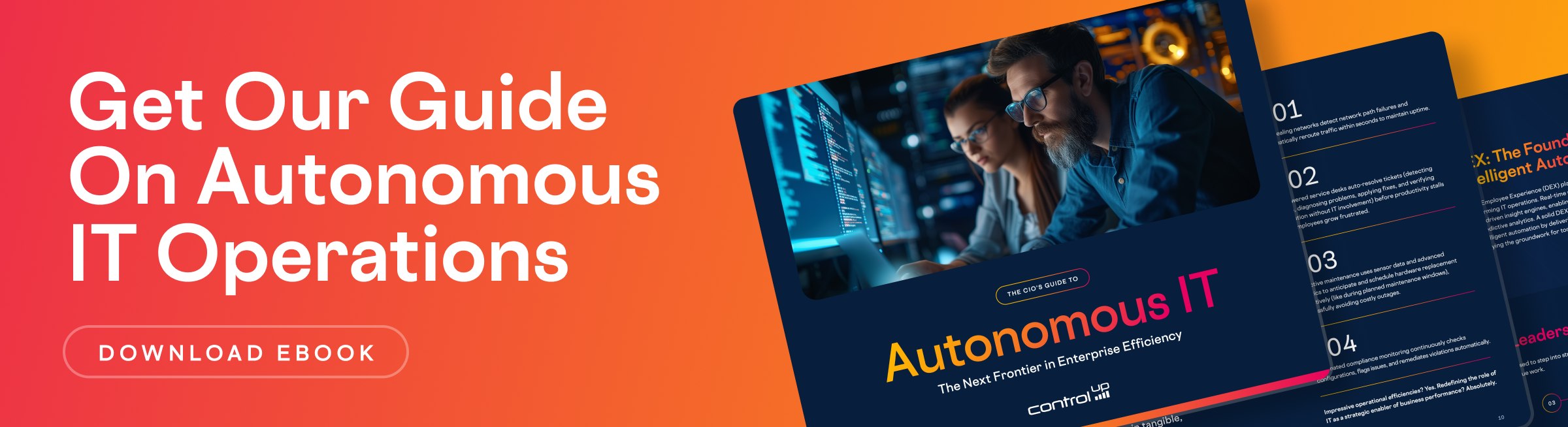
The ControlUp Approach: “Protection is in our DNA”
At ControlUp, we provide the blueprint and the building blocks for this immune system, combining the industry’s fastest real-time metric collection with a powerful engine for automated remediation. This allows IT teams to define the healthy baseline, arm the system with the “antibodies” to detect deviations, and empower “white blood cells (T cells)” to fix issues automatically.
When you implement a Digital Immune System, the results are transformative:
- Reduced “Sick Days” for Tech: Drastically cut downtime by fixing issues instantly, 24/7/365, without human intervention.
- Healthier Employee Experience: Users enjoy a consistent, performant digital workspace without constant interruptions.
- Freed-Up IT “Doctors”: When your Level 1 and 2 issues are healing themselves, your skilled engineers stop acting like digital janitors and start focusing on strategic, complex initiatives.
The future of IT isn’t about hiring more people to stare at dashboards. It’s about building an environment intelligent enough to take care of itself. It’s time to vaccinate your infrastructure against downtime.